Project
Scalable Smart-Meter Calibration of Urban Building Energy Models
Physics-supervised inverse surrogate learning to infer building energy model parameters from hourly smart-meter data, with uncertainty-aware calibration at urban scale.
Problem
Calibrating building energy models typically requires repeatedly adjusting uncertain inputs through optimization or Bayesian inference. Repeating this process for thousands of buildings is computationally expensive. Calibration also faces equifinality: different combinations of envelope, system, and schedule parameters can produce similar energy-use profiles, making a unique solution difficult to identify.
Method
This research develops a physics-supervised amortized inverse calibration framework around a reduced-order 5R1C building energy model. The approach shifts repeated calibration work into a shared training process, learning to infer plausible parameters directly from hourly electricity and gas profiles and known boundary conditions.
Synthetic training data are generated by sampling physical, system, and schedule parameters across weather and building conditions. Simulator-derived zone-air and thermal-mass temperatures provide auxiliary supervision, connecting the inferred parameters to the model’s internal thermal behavior.
My Contribution
As part of my doctoral research at Cornell’s Environmental Systems Lab, I develop inverse-modeling and surrogate-learning methods for calibrating building energy models from measured time series.
Evaluation Design
Four progressively enriched models isolate the contribution of each component:
- Deterministic inverse baseline: establishes parameter-recovery performance.
- Internal-state supervision: tests whether auxiliary thermal-state targets improve reconstruction of internal temperatures.
- Forward-simulation consistency: tests whether inferred parameters reproduce observed energy trajectories when passed through the simulator.
- Probabilistic inverse inference: represents uncertainty and multiple plausible parameter combinations.
Evaluation covers parameter recovery, internal-state reconstruction, forward reconstruction, uncertainty representation, and generalization to unseen observations.
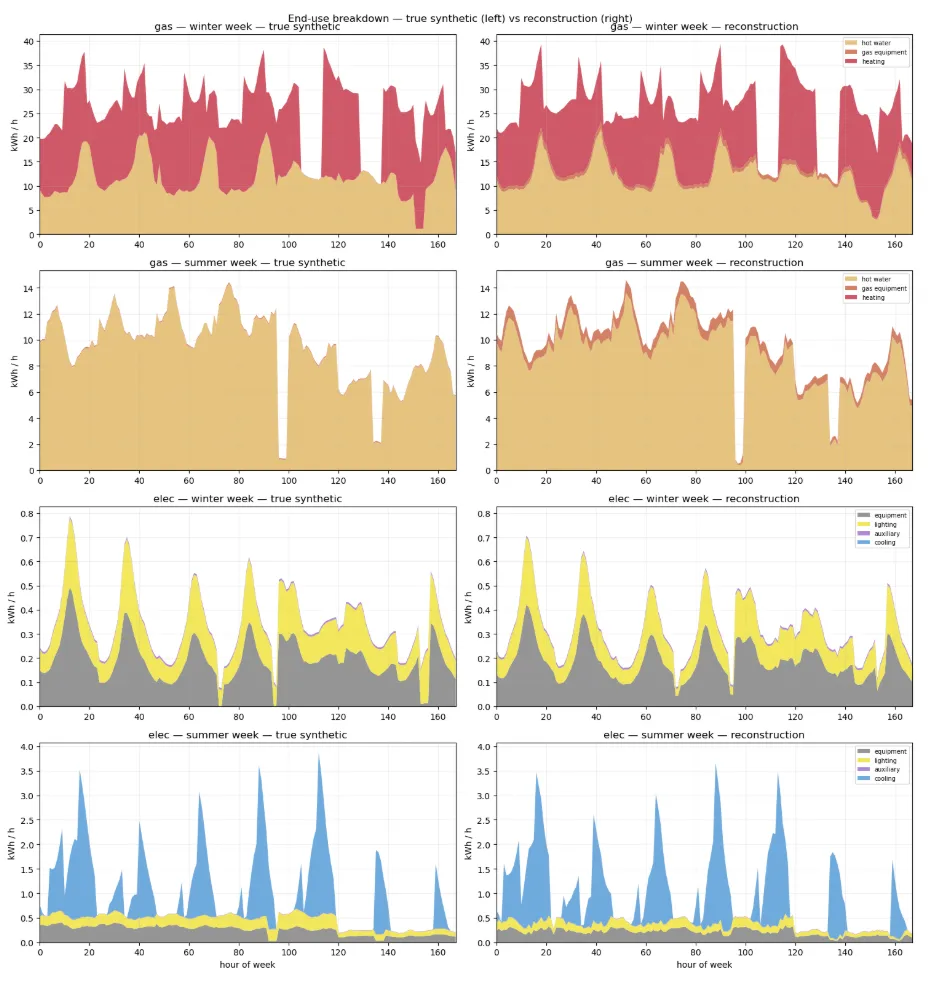
Synthetic end-use profiles (left) and their reconstructions (right) for winter and summer weeks. Gas profiles separate hot water, gas equipment, and heating; electricity profiles separate equipment, lighting, auxiliary loads, and cooling.
Building-Stock Application
The study applies the framework to approximately 40,000 buildings with one year of hourly electricity and gas smart-meter data. Performance is evaluated against held-out meter observations, with conventional iterative calibration on a representative subset providing an accuracy and computational-cost benchmark.
The central research question is whether amortized inference can make building-stock calibration computationally practical while retaining uncertainty in non-unique solutions.